Showing posts with label literature. Show all posts

Sunday, January 19, 2020

New Computer & Windows 10

-CC-9011075-WW-Gallery-100R-001
Corsair  Mid Tower Case with side window

Having taken possession of my new super duper computer last Wednesday, I have been accustoming myself to Windows 10.

Much as I dreaded upgrading to Windows 10, it has not been all that stressful and is pretty much like Windows 7, except bossier.

Gratifyingly, all my beloved antique software works fine without any problems. Amazing to discover that MS Office 2003 (the last MS Office with the old interface before the ribbon interface was introduced in Office 2007)  is still operable under the latest version of Windows.

The picture above is of the mid tower case of the new computer. Tower cases have gotten groovier these days -  a far cry from the boring beige boxes of the past.  There was one at the computer shop with flashy lighting effects, but I settled on the minimalist Corsair 100R case which has a side glass panel so you can see the computer’s innards, and no doubt how dusty it will get as the years go by.

It is a fast machine that comes with bountiful USB 3 ports and runs quietly.

So overall I’m really pleased I opted for a new computer and that Windows 10 has proved (so far) not to be the gremlin I had anticipated and was easy to customise to my liking.

One good thing about Windows 10, is that Open Live Writer now has a spell checker, unavailable on Windows 7 , so hopefully I won’t be making as many inadvertent mistakes. I have yet to test that it uploads to Google, but this post will be the proof.

On other matters I have several events booked in February and March, two literary occasions – Margaret Atwood at Hamer Hall on 23 February and Neil Gaiman at the Capitol on February 25 – and three music concerts. The first of these is Patty Griffin on March 3, followed by Eilen Jewell on 19 March and Kieran Kane on 26 March. So there’s lots to look forward to in this brand new year.

Hopefully I’ll be back at the races next Saturday at Caulfield. Alas, transport disruptions mean that I will have to catch a bus to Caulfield next week as trains are not running, though the rest of the autumn racing season at Caulfield appears not to be affected, in February at least.

The 2020 All Star Mile will be run at Caulfield this year in mid March and is shaping up as the race of the Melbourne autumn season, with a plethora of classy horses nominated. 

I witnessed the inaugural running of the race last year at Flemington, won by Tassie filly Mystic Journey. She is nominated again and will probably get a start. Let’s hope the P B Lawrence Stakes curse has worn off this autumn and that she can add another win to her tally.

Tuesday, December 31, 2019

So Long to the 2010s

bingo_recent 3
Bingo early December

I really can’t complain about the 2010s as I have been retired from work for  9/10ths of the decade, but globally the world is a different place to what it was in 2009.

Actually, in my humble opinion, the world changed for good on 11 September 2001 with the fall of the two towers and has been going downhill ever since.

Anyway, to see out the old year here are some of my highlights for this year.

Books

Though as usual I reread several old favourites, a number of new titles impressed me this year, notably two books by previously unknown authors – Diane Setterfield and Sarah Tolmie.

An engaging ghost story set on the river Thames, Once Upon A River by Diane Setterfield gripped me from the beginning. It’s a sort of old fashioned tale that you comfortably settle into and follow delightedly to its satisfying conclusion.

ImageHandlerThe Little Animals by Canadian writer, Sarah Tolmie, is the book I loved the most this year; an unremarked gem of a novel about Dutch scientist Antoni van Leeuwenhoek, known as the Father of Microbiology. He was a contemporary of the famous artist Johannes Vermeer who is also a character in the book. Another main character, who haunts the book and lends an otherworldly vibe to it, is the goose girl, transported from a Grimm fairy story to 17th century Delft to become a strange collaborator in van Leeuwenhoek’s scientific investigations into animacules (Little Animals). 

If like me you are weary of books banging on about modern social issues, The Little Animals is a welcome escape from these troubled times and a pleasure to read.

I also enjoyed new books by favourite authors – The Testaments by Margaret Atwood, The Secret Commonwealth by Phillip Pullman and two new books by the wonderful American writer John Crowley, And Go Like This, a book of short stories, and Reading Backwards an illuminating, exquisitely written collection of essays and reviews covering an astonishingly wide range of topics.

Alas John Crowley’s 25th Anniversary edition of Little, Big was not published this year – no surprise really. Hopefully I get to finally hold it in my hands next year after a 15 year wait.

Next year I’m pleasantly anticipating Agency by William Gibson in January,  The Mirror and the Light by Hilary Mantel in March, a new David Mitchell novel, Utopia Avenue, in June and after a 16 year hiatus Susanna Clarke (author of the magical Jonathan Strange and Mr Norrel) has a new novel titled Piranisi coming in September.

We’re not doing anything special this New Year’s Eve and will be asleep by midnight, possibly awakened by fireworks, but more likely the cat Bingo.

He’s now three years old and just as mischievous as ever, not to mention noisily vocal. But he is a beautiful looking animal and a dear little fellow most of the time.

Let’s hope summer is not too trying. A few 40C+ degree days is normal in Melbourne, and luckily the few we’ve had so far  have only lasted 24 hours with a cool change following in a timely manner and lingering for days.

The hot weather has affected the horse racing industry. Several recent race meetings have been abandoned due to the heat, which is to be commended. Hopefully when the Group 1 racing resumes in early February the weather will be kind, though that’s unlikely. We wait and see.

Anyway, I’m looking forward to the new racing season as I enjoy my Saturday afternoon outings to the track. It’s also pleasurable to speculate on the emergence of new stars of the turf in the Magic Millions two year old competitions in early January at the Gold Coast.

Whilst awaiting the new racing season I’ve been playing computer games, the current one on the go being Blade Runner, a 1997 game recently rejigged for modern computers by GOG.

Despite it’s 80s retro visuals, I recently  enjoyed a very well made game called Detective Di: The Silk Rose Murders.  The game is based on a real life ancient Chinese judge and investigator Di Renjie, who was also the hero of a series of novels by Robert van Gulick, quite few of which I have in my personal library.

As support for Windows 7 expires mid January, I’ll be obliged to either update my current computer to the dreaded Windows 10 or purchase a new one.  Despite this Windows 7 computer still going smoothly, I’m favouring getting a new computer for Windows 10 for several reasons. Firstly the SSD C: drive on this computer is running out of space, and secondly it being close to  five years old, the bios is pretty ancient and is probably not up to date or updateable.

I intend to buy another desktop with all the bells and whistles, ie a good graphics card, a fast CPU with lots of RAM. Hopefully my favourite old software will still work on a new machine and in Windows 10.

Windows 7 in my opinion has been the best version of Windows I’ve ever used. It’s stable, fast and problem free in the main and runs all my old beloved software programs.

This is turning into a marathon post, so I’ll end here, wishing my readers, whoever you are, a Happy 2020 and a more enlightened world.

Friday, May 26, 2017

Colson Whitehead–Black America Matters

colson whitehead 1
Colson Whitehead – Northcote Town Hall – 24/5/17

Colson Whitehead is the author of  six novels covering a variety of topics, and has recently attained fame and glory with his most recent novel, The Underground Railroad, which was championed by Oprah Winfrey and won the 2016 National Book Award and 2017 Pulitzer Prize.

A near full house was present at Northcote Town Hall on Wednesday night to see Colson Whitehead in conversation with Wheeler Centre Director Michael Williams.

michael williams
Michael Williams at Northcote Town Hall – 24/5/17

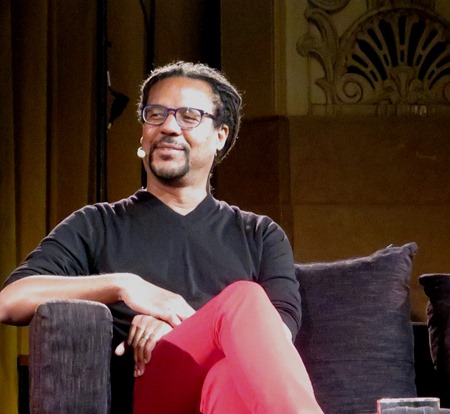
Colson Whitehead looks a cool guy and came across as unaffected and amiable, not making any big deal of being an American of black descent, though the conversation primarily  centred on that issue.

This focus was understandable in light of the subject matter of The Underground Railroad, it being about black slavery in America’s shameful past.

It was an interesting conversation as Colson Whitehead explained how he came to write the novel. He said that he had been thinking of it for many years before he finally wrote it, and that it took several years for it to be finished to his satisfaction.

He was astonished by the reception the novel received, particularly when he was obliged to appear on Oprah’s Book Club show.

colson whitehead 4
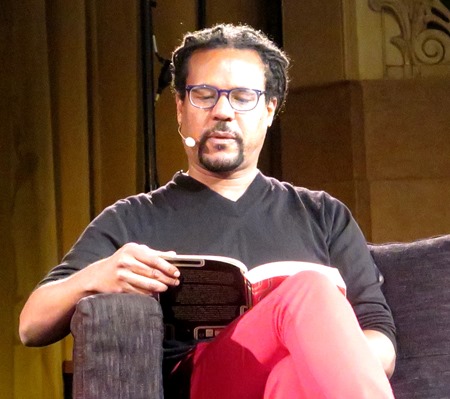
Colson Whitehead reads an excerpt from The Underground Railroad

I noticed that the event was filmed, but the podcast is now available to listen to here .

Tonight, I’m off to see Ryan Adams at Margaret Court Arena – can’t wait!

Tuesday, May 23, 2017

Strange Here: George Saunders consorting with ghosts

geroge saunders 1
George Saunders live at Northcote Town Hall 21/5/17

It has been a few years since I last attended a Literary event, the last being in 2015 when I had the pleasure of seeing David Mitchell and Jonathan Lethem.

Sunday night, as mentioned in my previous post, I attended the Wheeler Centre event at Northcote Town Hall that featured American author George Saunders, acclaimed short story writer, and now novelist.

I’ve never actually been inside Northcote Town Hall before, despite living in the neighbourhood for over 30 years. A grand classical edifice on the outside, the interior features genuine Art Deco motifs – very classy.

The evening took the form of a conversation between noted Australian writer and commentator, Don Watson and the special guest.

don watson
Don Watson at Northcote Town Hall – 21/5/17

George Saunders came across as a genial chap, interesting and funny.

My ambivalence to his novel Lincoln in the Bardo was turned around after seeing him speak about it.

The novel  is not really suitably set up for reading on a Kindle as I found the layout confusing and at times illegible when the font abruptly changed to italics set at a smaller point. This in turn detracted from the experience of reading the book.

It is undoubtedly a clever novel and passing strange, set as it is in a dead zone – the Bardo - inhabited by an extraordinary collection of ghosts, all with unique voices.

The evening’s discussion naturally centred on Lincoln in the Bardo and also touched on the present state of America under the Trump presidency in contrast to the America of Abraham Lincoln who has been regarded as an American hero throughout the nation’s history.

geroge saunders 3
George Saunders reads an excerpt from Lincoln in the Bardo

George Saunders also was asked about his writing methods, to which he responded that rigorous revision was the key ingredient of his development of plot.

He read a short excerpt from Lincoln in the Bardo, including the source references.  Ninety percent of these references are drawn from actual historical snippets, the rest are fictional.  George Saunders would not say which were real or which made up.

It was an illuminating evening and a privilege to see George Saunders in person.

Podcast can be listened to here.

Saturday, May 13, 2017

Winter is Coming…

But before it really hits Melbourne, I have several interesting events to attend by the end of May, that involve literature and music.

I could include art in that, but I’m holding off on the Vincent Van Gogh exhibition at the National Gallery of Victoria for a month or so, and plan to visit when the crowds have died down.

The Wheeler Centre is having a mini literature festival this May and two of the International writers who will be visiting Melbourne at the time are of interest to me, so I’ve booked tickets to see them at local venue, Northcote Town Hall.

ur6 The writers in question are American authors Colson Whitehead, author of the 2017 Pulitzer Prize winning novel The Underground Railroad, and George Saunders, renowned for his short stories, whose latest work is also his first novel, Lincoln in the Bardo.

I have read The Underground Railroad on my Kindle and found it an absorbing impressive novel and quite harrowing, the subject matter dealing as it does with black  slavery in the USA.

bardo As for George Saunders, I have copies of his first two collections of short stories, Civilwarland In Bad Decline and Pastoralia, both of which I enjoyed enormously, the quirkyness of his writing style and subject matter appealing to my taste for peculiar literature.

I am currently reading Lincoln in the Bardo on my Kindle and it certainly is a strange novel, which I am not sure I’m enjoying all that much.

So seeing both these authors soon, George Saunders on 21 May and Colson Whitehead on 24 May, will be interesting to say the least.

I have noted that Irish author Anne Enright is also part of the mini literary carnival, but have eschewed attending her event as I hated her Booker winning novel The Gathering and consequently felt no desire to read any of her other books.

It will be a busy week as far as events are concerned for the long awaited and highly anticipated concert of my all time favourite singer songwriter, Ryan Adams is on 26 May at Margaret Court Arena.

That will be the icing on the cultural cake as far as I’m concerned.

Tuesday, August 30, 2016

The Dictionary of Obscure Sorrows

25-emotions

I’ve always had an interest in words, and particularly relish neologisms, regularly visiting the wonderful Word Spy site. So when I came across a reference – on Facebook of all things! – to The Dictionary of Obscure Sorrows, it was love at first sight.

The Dictionary is the brainchild of John Koenig who has invented neologisms for emotions that are otherwise undefined. His blog expands on these words, using videos to illustrate the definitions.

The words at the beginning of this post are taken from The Dictionary of Obscure Sorrows. They posssess a haunting quality that almost need a word to express the feelings they evoke.

Then again you feel delighted to recognize the emotions as being pertinent to your own experience.

Perhaps he should develop a Dictionary of Obscure Joys, such as the soothing and warm feeling evoked when thinking of familiar things that interest you, in my case horse racing, which I find pleasant to contemplate.

Saturday, May 14, 2016

The Chemical Wedding–Book Collectors Delight

chemical wedding
Chemical Wedding cover image from Small Beer Press

I know, I know, I’m still waiting for the publication of John Crowley’s 25th Anniversary Edition (I wish she would wake up!) of his best loved work, Little, Big, but I couldn’t resist pledging to the Kickstarter for The Chemical Wedding, a four hundred year old romance by Christian Rosencruetz (Johann Valentin Andreae), re-imagined by  John Crowley, who dubs it the first Science Fiction novel ever written.

To mark the 400th Anniversary of the work, first published in 1616, Small Beer Press will be publishing this new version in November 2016 in diverse editions, paperback and eBook, and have launched a Kickstarter to fund the more exotic limited editions – an exclusive Hard Cover Edition, a Numbered Edition and a Lettered Edition.

Small Beer Press is an American independent publishing company founded and run by husband and wife team, Gavin J Grant and Kelly Link. They publish a range of fine speculative fiction and non fiction. They also established Weightless Books, a DRM free source of eBooks from independent publishers. 

Anyway, The Chemical Wedding looks as if it will be a splendid edition and a real collectable, destined to become a rare book classic. Illustrated throughout with whimsical woodcuts by Theo Fadel, John Crowley’s artist of choice for the book, makes it extra special.

The Kickstarter offers many reward levels, and there are some tempting goodies, such as (limited) signed and inscribed first editions of John Crowley novels, if you pledge for the Hard Cover. Every level from $10.00 upwards receives a DRM free eBook of The Chemical Wedding in the eBook format of your choice.

If you are a serious bibliophile and love fine editions, the Kickstarter for The Chemical Wedding gives you the opportunity to acquire an exceptionally beautiful first edition at a good price.

Fortunately we will not have to wait 11+ years for it to be published, as Small Beer Press expect the books to be available in October or November 2016.

It will be interesting for me to see which book will arrive first in my mailbox – Little, Big 25 or The Chemical Wedding. Let’s say, I’m not holding my breath for Little, Big as there has been no news on its publication since December last year.

Sunday, May 08, 2016

Instead of a Love Poem by Adi Sappir

Instead of a love poem cover cdbaby

The cello is a melancholy  instrument that evokes a sense of yearning and nostalgia. It is the perfect musical vehicle for introspective and thoughtful songs.

Such is the case with cellist and singer, Adi Sappir’s recently released EP, Instead of a Love Poem, her tribute to Israeli poet Yehuda Amichai.

Adi is Israeli born but makes her home in Melbourne these days and is well known as one of the local trio, The Mercurials, whom I have reviewed previously.

I must admit I had never come across the poetry of Yehuda Amichai, but have since addressed my ignorance of his work, after Adi asked me to review her EP.  He is acclaimed in both Israel and Internationally as poet of remarkable intelligence and acuity, writing about the universal themes of love, death and old age in a fresh and interesting way.

Instead of a Love Poem contains six songs set to Yehuda Amichai poems.  It is a moving celebration of his work, masterfully expressed in music, Adi’s affecting voice blending with the rich tones of her cello to create a soundscape of mournful beauty.

The added accompaniment of piano, organ and vocals enrich the listening experience, interacting perfectly with the dark sad sound of the cello and Adi’s voice.

Track Listing

  1. Jerusalem
  2. Take Me To The Airport
  3. Air Hostess
  4. God Full Of Mercy
  5. Ecology of Jerusalem
  6. Such As Sorrow

You can purchase a digital copy of the EP from CD Baby or buy the physical article on Adi’s webite.  The buy option is hard to see, but look for the red text link above the EP cover image.

Monday, November 23, 2015

Costume Drama with Magic–Jonathan Strange & Mr Norrell

jonathanstrangeandmrnorell
For the past week I’ve been in thrall watching the superb translation to screen of one of my favourite novels, that being Jonathan Strange & Mr Norrell by Susanna Clarke, published in 2004.

Most of the time when you watch a screen version of favourite novels there is a sense of disappointment, but not so in this case. The casting is spot on, the cinematography is wondrous to behold, and the book is translated faithfully to screen.

Of course there are some gaps, but it is understandable in the case of Jonathan Strange & Mr Norrell, it being a voluminous complex book with a multitude of delightful footnotes, which are only fleetingly quoted in the TV series.

The story is an alternate history of England set during the time of the Napoleonic Wars, where Magic has been rediscovered after a long period of disuse.

Two magicians, the eponymous gentlemen of the title, have found a way to practice magic, Mr Norrell drawing his knowledge from books, Jonathan Strange having a natural talent for it.

Mr Norrell is the first to demonstrate practical magic, causing statues in a cathedral to come to life, and raising Lady Pole from the dead.

The latter act has consequences that involve the Gentleman with the Thistledown Hair, who claims half of Lady Pole’s life in exchange for his help in her resurrection.  The Gentleman is a Fairy whose motives are not in the least benevolent.

The DVD version of the BBC TV Series contains the full 7 episodes and I watched one episode a night, not wishing to rush through it, but savour each episode as it happened.

I’m left haunted by it along with a strong desire to read the novel again, which I recall is elegantly written in a dry witty tone.

The screen version of Jonathan Strange & Mr Norrell is a high quality production and one of the best I’ve seen. The sets and costumes are magnificent and the cast, as mentioned before, are true to character.

Highly recommended if you’re looking for something different to watch from the usual fare.

Wednesday, May 20, 2015

More Literary Luminaries – David Mitchell & Jonathan Lethem at The Edge

david mitchell 2
David Mitchell with Suzanne Donisthorpe – Deakin Edge 19/5/15

When David Mitchell last visited Melbourne in May 2011, a big crowd turned out to see him at the Athenaeum Theatre. The venue this time was Deakin Edge at Federation Square, a modern and edgy space – a startling contrast to the old fashioned charms of the Athenaeum -  but an equally large number of fans were present last night.

I managed to get a seat in the front row, as is my wont with music shows, i.e. my favourite spot to be. So my view was unimpeded.  I took along the Canon G16 this time and shot some decent photos.
David Mitchell bounced onto the stage greeting the audience with a friendly hello as he took his seat. The topic of discussion was of course his latest novel The Bone Clocks, a mind teaser of a novel that involves several different narratives like his earlier novel Cloud Atlas. The Bone Clocks however has a central character, Holly Sykes, who appears peripherally in the various other character’s stories. There is a supernatural thread running through the novel, and indeed there’s a terrific supernatural battle towards the end. The prose is dazzling and pleasurable to read.

It was an engrossing conversation and David Mitchell presents as charming and unaffected, funny as well.  It was thrilling to be present in person at the event, seeing one of my favourite writers in the flesh again.

There was some discussion about whether Mitchell is writing an “uber” novel as in each of his books characters from previous books reappear. There is a scholarly work entitled  A Temporary Future: The Fiction of David Mitchell by Patrick O’Donnell, a study of all David Mitchell’s fiction up to The Bone Clocks which explores this idea. I have a copy of it, which I have yet to read in full. It’s somewhat abstruse and hard to read, I must admit, but I’ll persevere with it when I run out of more engaging reading matter.

The video of the interview with David Mitchell is now available on the Wheeler Centre website:

david mitchell 5
David Mitchell reading from The Bone Clocks –note: the protrusion on David’s lip is the remote mike.

I had taken along a big bag of books – it weighed a ton –  with five Mitchell novels and some of my collection of Jonathan Lethem novels.

One of the disadvantages of sitting in the front row, is getting out of the venue quickly enough to get a forward spot in the book signing queue.  It was a long queue and moved fairly slowly, but after hanging on for at least half an hour, I was able to get the rest of my David Mitchell collection signed, and express my appreciation for the care he takes in creating beautiful sentences, which was something he talked about in the session.

jonathan lethem 2
Jonathan Lethem & Chloe Hooper - Deakin Edge 19/5/15

It would have been a perfect occasion seeing just David Mitchell, but Jonathan Lethem was the icing on the cake.

His latest novel is Dissident Gardens, a “multigenerational saga of revolutionaries and activists, the civil rights movement and the counterculture, from the 1930s Communists to the 2010s Occupy movement, and is mostly set in Sunnyside Gardens, Queens and in Greenwich Village” from Wikipedia.

I recently read this novel and identified with the period and its leftist sympathies. It took me back to my revolutionary days in the 1960s and 70s.

The two leading characters are Rose Zimmer and her daughter Miriam and their strong personalities are portrayed vividly, Rose in particular.  Jonathan Lethem said in the discussion that Rose was based on his Communist grandmother and Miriam on his activist mother, who died when he was 13 years old.

His novel The Fortress of Solitude is semi autobiographical, set as it is in Brooklyn, where Jonathan Lethem lived as a child.

He had an unconventional bohemian childhood and originally wanted to be an artist like his father. However, from an early age he steeped himself in counterculture falling in love with books and music of all genres, and spent 12 years working in second hand bookstores whilst writing his early novels. He said he loved old battered second hand books and unfashionable writers of whom nobody, these days, has heard.  

jonathan lethem 3
Jonathan Lethem reading an excerpt from Dissident Gardens

Not as many people attended the Jonathan Lethem event, so the signing queue was shorter. Jonathan was friendly and pleasant in person, and obligingly signed the six novels I’d brought along, remarking on my old paperback copies of his first two books. He’d be pleased to know that three of the novels I took along were second hand copies.

A video of Jonathan Lethem's interview is also available on the Wheeler Centre website.

The four literary events that I have attended in the last week, were all different and interesting, from the old school literati of Claire Tomalin and Michael Frayn, to the young bloods of the Internet age  in the persons of David Mitchell and Jonathan Lethem, they were more than worth the cost of entry.

I hope to attend more in the future.

Friday, May 15, 2015

The Warm Glow of Literary Lights

Last night I attended the first of the literary events I had booked for at the Wheeler Centre, that being the double header of married literary lights Claire Tomalin and Michael Frayn.

They are now both 81 years old, but they certainly don’t look it nor had their mental acuity been tempered by age. Both events were interesting in different ways.

Claire Tomalin is a noted biographer of such literary figures as Charles Dickens, Jane Austen, Samuel Pepys, Percy Shelley and Mary Wollstonecraft. She created a storm of controversy when she revealed in her biography of Dickens, that he had long term mistress, for whom he abandoned his wife and children. Claire Tomalin also wrote a biography – The Invisible Woman - of said mistress, Ellen Ternan,  a young actress, who by all accounts led a very interesting life, ending up, after Dickens death, as a respectable woman, managing to keep her relationship with Dickens and her previous less than respectable life a secret until her death.

mary w

Claire Tomalin was interviewed by local writer Toni Jordon and spoke at length about her life and works.

She wrote her first book, The Life and Death of Mary Wollstonecraft in her late thirties, her life up to that time being busily filled with her career as Literary Editor for New Statesman and The Sunday Times as well as bringing up her children.

The Wollstonecraft biography was a great success and won the Whitbread Book Award in 1974. I have a copy of the hardcover, but it is not the first edition, which according to Claire Tomalin, was a small issue. My copy is the second edition published in 1975. However I did take it along last night and got it signed by the author.

OLYMPUS DIGITAL CAMERA
A somewhat out of focus Claire Tomalin signing books.

The discussion evolved into the question of how Claire Tomalin chooses her biographical subjects. She remarked that in the process of researching and writing a biography she felt as if she was obliged to live their life and she was attracted to subjects that she could love. Her emotional engagement with her biographical subjects was profound and she admitted to weeping when she wrote of their deaths. She makes a point of literally walking in her subjects shoes, traversing on foot the locations in which they lived their lives.

Her favourites, she stated were Mary Wollstonecraft and Samuel Pepys.

It was an engrossing hour of conversation and I was delighted to have been present for it.

The event was pretty well booked out and was held at the Wheeler Centre in the former Barry Hall in the South Wing of the State Library in Little Lonsdale Street. The audience was mostly in the older age group, though I did spot a few young faces.

The Michael Frayn event was a completely different kettle of fish. He was introduced by Chris Mead , the Literary Director of the Melbourne Theatre Company, so his emphasis was more on Michael Frayn’s theatrical creations, though the acclaimed literary light is noted for his journalism , novels and screen writing as well as his dramatic works. His segment was titled “How To Begin”, so Michael Frayn began by talking for at least twenty minutes on how he came to a writing career.

OLYMPUS DIGITAL CAMERA
Also out of focus, Michael Frayn speaking on the podium.

He was a humorous and entertaining speaker, having a fine sense of irony and an appreciation for the ridiculous things life throws up, relating several stories where he was the butt of the joke.

This year, 2015, is the 50th anniversary of the publication of his first novel The Tin Men, and he has 10 other novels to his credit. His plays include Copenhagen, Democracy and Noises Off.

He didn’t start to write for the theatre until the 1970s, eschewing the literary form out of prejudice caused by a rejection of his first attempt at theatre in his University days. 

I notice on the Wheeler Centre website that events are recorded for posterity, so you can view some past events about a month after they occurred, should you be interested in checking them out.

It was a chilly day yesterday, Melbourne shivering under an early onset of winter, so it was good to venture out and bask in the warm glow of literature. It’s a pity my photos didn’t turn out well, but I was nervous about taking photos in the venue, so the two photos above are sneak shots hastily snapped on my smallest and not very good camera.

Next Tuesday I am looking forward to seeing the David Mitchell - Jonathan Lethem double header at Deakin Edge in Federation Square.

The horse racing scene is rather dull in Melbourne at the moment with the Group 1 action happening in Adelaide this weekend and in Brisbane throughout late May and June, but I have booked for several concerts over the coming months, the first being Iris Dement on 28 May.

I’m particularly delighted that my favourite artist Ryan Adams is coming in July. Both his Melbourne shows have already sold out, but I managed to get tickets for both nights.

I’ve got winter covered, entertainment wise at least.

Wednesday, April 01, 2015

A Literary Smorgasbord–The Wheeler Centre 10 Days in May

I’m excited!

In the past I have been disappointed in missing several writers I should have liked to see in person at Melbourne’s Wheeler Centre but heard about the events too late or not at all.

One of the authors I missed whom I would dearly love to meet was Karen Joy Fowler, author of the wonderful We Are All Completely Beside Ourselves and The Jane Austen Book Club among other fine novels. The event was not advertised and I heard later that it was not well attended, so I figured that if I was to get news  of such events I should sign up for the Wheeler Centre newsletter if they had such a service.

I signed up a few months ago and it paid off handsomely the other evening when I received the Wheeler Centre newsletter with details of their Ten Days In May mini festival -  a spill over of International writers from the concurrent Sydney Writer’s Festival. 

Among them are two of my favourite authors – Jonathan Lethem and David Mitchell.

david_mitchell 007David Mitchell is famous, a modern literary lion adored by his reader fans for his clever books and beautiful prose style.  I did have the pleasure of seeing David Mitchell live several years ago and got my copy of his book The Thousand Autumns of Jacob De Zoet signed. This time I’ll be taking along a few more of his books including his latest, The Bone Clocks, to be signed.

Jonathan Lethem photographed on the campus of Pomona College.Jonathan Lethem on the other hand  is not all that well known in Australia, except perhaps in Science Fiction circles.  He actually doesn’t write science fiction, but his books often contain fantastic elements. In my opinion his masterwork is Motherless Brooklyn, a sort of detective mystery whose narrator suffers from Tourette’s Syndrome.

I have been following Jonathan Lethem’s career from his first book titled Gun with Occasional Music, a hard boiled detective satire set in a bizarre future.  His second novel Amnesia Moon was just as strange – described on the cover as an amazing road noir novel of the fractal future. I have yet to read his latest novel Dissident Gardens, but intend to do so before his appearance in Melbourne.

I’ve booked for both of the above authors who will be at the Atrium, Federation Square on 19 May, one after the other.

It seems I have inclination to soak up  culture at the moment, for I’ve also booked tickets for Claire Tomalin and Michael Frayn who will be at the Wheeler Centre on 14 May, also as part of the mini festival. 

Claire Tomalin is a notable journalist and writer of several biographies of historical figures- Jane Austen, Samuel Pepys, Charles Dickens, to name a few. I have her biography of Mary Wollstoncraft in hard cover, which I purchased way back in 1975, so I’ll certainly be taking it along to be signed.

She is married to Michael Frayn who is known for his clever satirical novels. I have only one in my collection – his first novel,  The Tin Men, in a 1974 paperback.

I notice Helen Macdonald, author of H is for Hawk , a book I greatly enjoyed reading last year, is a guest at the Sydney Writer’s Festival. I’m disappointed that she will not be seen in Melbourne during that time, unless she comes later.

Friday, July 05, 2013

Edward Whittemore in the 21st Century

I have mentioned the novels of American writer Edward Whittemore previously and indeed for 12 years have maintained  Jerusalem Dreaming, a Whittemore tribute website.

So I was pleased to learn that new eBook editions of his five novels will be published on 23 July 2013 by Open Road Media.

Whittemore_QuinsShanghai_ebook_m Whittemore_SinaiTapestry_ebook_m Whittemore_JerusalemPoker_ebook_m
Whittemore_NileShadows_ebook_m Whittemore_Jericho_ebook_m EWa

Above, cover art for the new eBook editions and a photo of Edward Whittemore taken by his life long friend Carol Martin.

Edward Whittemore is best known for his Jerusalem Quartet, a series of novels set in the Middle East, composed of  Sinai Tapestry, Jerusalem Poker, Nile Shadows and Jericho Mosaic. Quin’s Shanghai Circus was his first published novel and is set in Japan and China. It was published in 1974 and the Quartet followed, its four novels being published over the period 1977 to 1987.

Edward Whittemore died in August 1995 of prostate cancer, but his literary work lives on, though even now is not all that well known. He remains an obscure and mysterious writer, but deserves to be a household name.  The books are quite wonderful in the truest sense, full of marvellous and strange events - a secret history of the Middle East no less - funny, humane, wise and beautifully written.

I readily admit that the novels of Edward Whittemore changed my life. When I first discovered Sinai Tapestry back 1979, I became obsessed by it and eagerly looked for any further books by the author. Eventually Jerusalem Poker was published in a UK paperback in 1980 and I realised that the two novels were part of a series.  The later volumes of the Quartet were only available in US hard covers, so I went to great lengths to acquire copies. This was before the Internet and the books were impossible to find in Australia, so they had to be specially ordered.

When I finally acquired Internet access in 1997, one of the first things I searched for was Edward Whittemore novels, whereupon I learned of his death.

As there was very little information on Edward Whittemore on the Internet, it occurred to me that someone should create a website for him.  That someone was me.  I had  long been wanting to create a website after learning how to use Dreamweaver, so this tribute site was the ideal opportunity. It has gone through three designs in the 12 year period it has been online, and still remains my favourite of all the sites I have created or managed. And it still serves its original purpose; to be a repository of Edward Whittemore information, and a lasting appreciation of his literary oeuvre.  I’ve had lots of help over the years with contributions of articles, photos, ephemera etc. donated by people  across the world.

In the process of creating the Jerusalem Dreaming website I came to communicate with several people who had been personally acquainted with Whittemore, and eventually that led me to attending the launch of his reissued novels in New York in 2002. It was quite an adventure for the sedentary creature I was at the time, and I enjoyed the experience immensely.

gotham invite

I also wrote a long essay on the novels, which was published by the New York Review of Science Fiction in January 2003 – my one claim to publishing glory.

Though my essay was published in the NYRSF, Edward Whittemore’s novels are not in any way Science Fiction, though they have their fair share of magic realism.

It’s good that Open Road Media has taken on the task of publishing the eBooks, as their list is pleasantly catholic, with diverse genres represented. Whittemore is in good company, along with authors such as Barbara Pym, Michael Chabon, Pearl S Buck, Frederick Forsyth, Carl Hiaasen, the list goes on.

Naturally I have quite a large collection of Whittemore books, even though he only had five published, so they represent multiple copies of each of them. I have hard cover first editions, a complete set of the Old Earth Books paperback editions, and others in various languages – French, Dutch and Russian. I’ll no doubt add the eBook versions to my Kindle, so I’ll be able to read them at my whim.

So if you’re looking for books to escape into, books that might even change your life, or make your soul grow – as one Whittemore admirer averred – search no further.  The wonderful books of Edward Whittemore will be readily available again very soon in the most popular eBook formats.

Sunday, February 10, 2013

If You Read One Book This Year…

…it has to be The Orphan Master’s Son by Adam Johnson. 

When I wrote in my recent review of Barbara Kingsolver’s new novel Flight Behaviour, that it would take a really special book to knock it off the top my list of favourite reads for 2013, I didn’t expect one to come along so soon.

The Orphan Master’s Son was actually published last year and my attention was drawn to it in the Washington Post’s 50 Notable Works of Fiction for 2012 list.  I made a note of it at the time and downloaded the Kindle version recently. 

orphan master's son

Set in North Korea during Kim Jong Il’s reign, it is the story of orphan Pak Jun Do, who is variously a tunnel fighter in the DMZ, a kidnapper and a radio interceptor on board a fishing ship at sea. It is also a chilling portrayal of the 1984 world that is present day North Korea.

However, the novel is not as grim and depressing as you might expect. In fact some parts of it are very funny and others are heartbreakingly sad. It has scenes of gross brutality, but beauty and self sacrifice too.

Some of my favourite writers were also taken with the book.

David Mitchell writes that it is “An addictive novel of daring ingenuity; a study of sacrifice and freedom in a citizen-eating dynasty; and a timely reminder that anonymous victims of oppression are also human beings who love. A brave and impressive book.”

Zadie Smith writes “The Orphan Master’s Son performs an unusual form of sorcery, taking a frankly cruel and absurd reality and somehow converting it into a humane and believable fiction. It’s an epic feat of story-telling. It’s thrillingly written, and it's just thrilling period.”

I totally agree with David Mitchell, Zadie Smith and the following critic, whoever he is:

“I've never read anything like it. This is truly an amazing reading experience, a tremendous accomplishment. I could spend days talking about how much I love this book. It sounds like overstatement, but no. The Orphan Master's Son is a masterpiece.” —Charles Bock

Let it be noted that The Orphan Master’s Son is destined to be a classic, cult, or otherwise, and it’s a rare thrill to discover such a marvellous new writer.

The Orphan Master’s Son has joined my list of all time favourite books. This time, while reading the novel, I realised that it was the first time I was reading a novel I would reread over and over again, and savoured it as such. You never re-experience that thrill of reading a masterpiece for the first time, ever again, though subsequent readings reveal new insights and depths unseen initially.

You can get the physical book very cheaply in Australia. I found a copy of the paperback at The Book Grocer for $10.00, as a present for a friend, though I have sourced and have purchased a signed hard cover first edition for myself.

Tuesday, September 25, 2012

Merivel – A Man of his Time

“A smile spreads across the King’s countenance. It is a familiar smile, one that says ‘this is why I like you, Merivel, why I love you, even, because you lighten what is heavy and make laughter from sorrow’.”

merivel-a-man-of-his-time

Rose Tremain’s 1989 novel Restoration has been, and remains one of my all time favourite novels. It introduced the character of Robert Merivel, courtier and physician to King Charles II  spaniels and followed his rise to a position at court, his fall from grace and his restoration to the King’s favour during the heady early years of Charles II reign. 

Robert Merivel is one of the most compelling and endearing literary characters ever created.  His voice is unique – self deprecatory, alternately comic and wise. He leaps from the pages of  Restoration from the first sentence, introducing himself to the reader with the following words:

“I am, I discover, a very untidy man.
Look at me. Without my periwig, I am an affront to neatness. My hair (what is left of it) is the colour of sand and wiry as hogs’ bristles; my ears are of uneven size; my forehead is splattered with freckles; my nose. which of course my wig can’t conceal however low I wear it, is unceremoniously flat, as if I had been hit at birth.”

The novel, needless to say, is wonderfully written and the character of Merivel is complex and credible.  You smile with him as he relates the folly of his existence, wince in sympathy when he all too humanly errs in judgement, mourn with him when tragedy strikes and laugh with him when fortune shines once more.

He is a great character, so it was with delight that I discovered that Rose Tremain had decided to continue his story in Merivel: A Man of his Time. I pre-ordered the novel as soon as I learned of its publication and have subsequently read it.

I read it slowly, wanting to savour the rare pleasure of reacquainting myself with one of my favourite characters in literature.  It is set 15 years after the events related in Restoration. Merivel is now middle aged and living at Bidnold, his beloved estate in Norfolk, restored to him by the King during the intervening time.  His daughter Margaret is now 17 years of age and unaware of her origins; that her mother, who died at her birth, was a former inhabitant of a Bedlam where Merivel was obliged to work after his fall from grace in Restoration.

Merivel is still assessing his life and lamenting the lack of meaning it has for him. The discovery of his old memoir – hidden under the mattress of his bed – which he promptly nicknames “the wedge’ owing to it being a prop at the base of the bed, undiscovered over the years, prompts him to review his present circumstances. His daughter, now grown into a delightful young lady loved by all, is due to travel to Cornwall  with family friends, leaving her father bereft of her company for several months. Merivel decides to expand his horizons with a visit to the court of Louis XIV.

And so he sets out on a new adventure, and many are the pitfalls and follies that appear to dog his path, brightened by his encounter with the intelligent Louise, unhappily married to a member of the Swiss Guard whom Merivel, as is his way, nicknames “The Giraffe” .

The new novel is just as good as Restoration, but perhaps is darker and more melancholy than the earlier book. There is humour aplenty, but also sadness and poignancy as well.  I found  it engrossing and highly enjoyable to read. It made me smile, just as Merivel smiles at the oddities of his life.

Saturday, July 07, 2012

Living with the Russian Princess

talya2

Since Tuesday I have been living two doors up from the Cat Politics domicile, cat & house sitting for B & B who have flown to France for a long holiday bicycling through the French countryside.

Pictured above is Talya the Russian Princess, who is a sweet cat of the Russian Blue breed. The breed is characterised by their wonderful silvery blue fur and quiet and gentle temperament.  This is quite a change from the rambunctious nature of my own cats, or surviving cat as in Willy, who has a powerful personality and demands attention in no uncertain terms.

It took a few days for Talya to get used to me, but now we’re good friends and she welcomes me with every sign of pleasure when I return from an outing. No doubt the hand that feeds has something to do with this, but she is no longer aloof and timid as she was at first.

So here I am in a comfortable warm house with a lovely undemanding cat for company. Peace and quiet rules as opposed to the racket of renovations. Apropos the renos, they appear to be progressing well and most of the previously floorless rooms have the flooring base laid, on which the boards will be placed.

I have my notebook computer, a selection of my favourite CDs and a bag of books. I selected the books on size mostly; monster tomes that will keep me in reading matter for a few months. I am currently rereading Kristin Lavransdatter by Sigrid Undset, a trilogy of historical novels set in 14th Century Norway. It has been many years since I read this book. According to a site I came upon on the internet a new translation is available. The version I am reading is a Picador published in 1977, so no doubt it is the maligned old translation.  Notwithstanding the translation’s shortcomings, it is still an engaging and absorbing read.

Wednesday, February 15, 2012

The Late Lord Byron by Doris Langley Moore

As a change from horse racing, with which I appear to be obsessed at the moment, I feel inclined to post a review of the book that has occupied my reading time for the past week.

the-late-lord-byron-a-biography

My attention was drawn to Moore’s The Late Lord Byron, by a passing mention to it by Jessa Crispin at the Bookslut blog, in reference to an article on the destructive power of  literary heirs published in the Independent on January 6 2012.

Having always had a fascination for Lord Byron, this  piqued my interest, and I ordered a copy of The Late Lord Byron from Book Depository.

It was first published in 1961, but had been out of print for many years until it was picked up by independent publisher, Melville House for inclusion in their Neversink Library in 2011.

Doris Langley Moore is chiefly known for two accomplishments. She was a noted fashion historian and founded The Costume Museum in Bath in 1963 . She designed Katherine Hepburn’s wardrobe for The African Queen.

She was also a respected Byron scholar.

The Late Lord Byron is acknowledged as one of the best biographies on the famous poet and presents as a gripping literary detective investigation.  As the title indicates, it concentrates on what happened after Byron’s death. 

Drawing on previously unpublished letters, journals and news items as well as the plethora of Byron literature that was published after his Lordship’s death, Doris Langley Moore develops a picture of the period, and the people, both friends and enemies of Byron who contribute to his notoriety or fame as the case may be. The scholarship is formidable, with Moore backing up her commentary with many quotations and footnotes.

Despite the formidable scholarship, The Late Lord Byron is a delight to read, no doubt due to the tone – somewhat tart and ironic – that Moore adopts in laying out her case.  Her sharp observations and logical approach make her argument very convincing. 

One is appalled by the hypocrisy and mendacity of  such Byron contemporaries as Leigh Hunt who was one of many who published a biography or memoir of the poet with scant regard for truth, and upon little acquaintance with the subject.

It certainly seems unfortunate that Byron attracted so many unpleasant and dishonest persons to himself, who after his death went on vilify him in prose for profit or self promotion.

His friends, chiefly John Hobhouse (a close friend from his student days)  Augusta Leigh (his sister)  Thomas Moore (to whom he entrusted his Memoirs) and Teresa Guicccioli (his mistress in Italy) are seen to protest, but are hardly heard. 

Langley Moore’s theory is that having summarily burned Byron’s memoirs shortly after his death, Hobhouse who was Byron’s literary executor, ever after regretted the act and couldn’t bear to release any of the material he had in his possession, which might show his friend in a better light.  

What emerges from this study of Byron, is a picture of a man very much misunderstood by the period in which he lived. His virtues outweighed his faults – he was a charming, kind, considerate person and generous with money and was well known as a witty and entertaining conversationalist. He loved animals and laughter. So, he had a temper and was over emotional, but you get the feeling that he certainly had to tolerate many fools.  Overall he sounds like a guy you’d like to meet.

Next, still being in the mood for some Lord Byron, I might reread John Crowley’s Lord Byron’s Novel - The Evening Land, a fictional account of the discovery of an unknown novel by the said Lord which includes the novel itself.

And just because I cannot resist a mention of horse racing, I noted a remark by Langley Moore regarding Ada Lovelace, Byron’s daughter, that she “contrived a system for betting on horses that would have been infallible had it not been for the  interference of horses and jockeys”.

Wednesday, August 24, 2011

The Sense of an Ending by Julian Barnes

barnes_ending

I keep forgetting how much I admire the writing style of Julian Barnes, but as soon as I start one of his books it all comes back; how enjoyable they are to read.

It was thus I began this latest of his novels, The Sense of an Ending yesterday; a few pages into the novel, I recognised its quality and relished the thought that there were many more pages to go.

Not that many, actually,  as it is a short novel of 150 pages.  A lot is packed into those 150 pages, as the narrator Anthony Webster, a 60 something divorcee, recalls certain events in his life, after receiving an odd legacy from the mother of one of his old girlfriends.

The predominant theme of the novel  is memory – its trustworthiness or rather its fallibility and how liable a person is for the actions of their life in relation to other people. Theories of history also play a part in the novel, in terms of truth and reliable reportage of facts.

Despite the novel being written from a male point of view I found myself identifying with it, being at that 60 something age myself. However, in my case, I smugly thought, I have a record I can refer to in my diaries, which I kept for 20 years or so.

I mean to reread them at some stage, not to vicariously relive my youth, but to clarify my memory of times past. It could be very embarrassing, reading one’s callow youthful thoughts, but then again it might be enlightening and finally force me to decide whether to retain them for future generations or destroy them.

Sorry to get off the track, but perhaps the protagonist of Barnes’ novel would have benefitted from keeping a journal.

Be that as it may, of all the Booker long list novels I have so far read, The Sense of an Ending strikes me as a likely winner of the prize. It has a maturity and quality quite lacking in the others, which were entertaining and well written, but hardly prize winners.

Monday, August 22, 2011

Books – Currently Reading

I seem to have consumed a great many books over the winter, the last few weeks being especially intensive.

The Booker  long list was announced on 26 July, and I noted at the time that I had not read a single one. Normally there are one or two that are worth looking at, even if they don’t make it to the short list, let alone win the prize. I‘m often baffled by the selection of the winner, last year’s winner,  for instance, The Finkler Question, which I got around to reading after the award was announced, and subsequently  loathed, though I loved the 2009 winner Wolf Hall.

This year’s long list seems diverse and interesting, so I decided to give some of them a go,  my stricture being that they must be available in ebook format and be appealing in one way or another to my taste. Normally I would only get around to reading a small selection of the Booker list, as the expense of buying books in Australia is prohibitive and besides, half the list is not available here at all.

The Kindle comes to rescue again, so this year I can sample those books on the long list available in ebook format at less than half the cost of a regular book.

So far I’ve read three of the long list; a seafaring tale, a western and a Victorian mystery thriller set around horse racing. All were very different and all were entertaining and interesting to read.

1298748356_Jamrachs Menagerie - Carol Birch_w325_h500

The seafaring tale is Carol Birch’s Jamrach’s Menagerie, narrated by Jaffy Brown, who opens the novel with the following statement:

I was born twice. First in a wooden room that jutted out over the black waters of the Thames, and then again eight years later in the Highway, when a tiger took me in his mouth and everything truly began.

Jaffy’s adventures, after being saved from the tiger by Jamrach of the title, and given a job as yardman and animal carer in the menagerie, eventually take him to sea in quest of a dragon. The voyage ends in shipwreck and what follows thereafter is one of the most harrowing reading experiences I have ever undergone.  Towards the end of the book Jaffy recaps his life as follows:

 One way or another I suppose you could say that voyage was the making of me. I’d have been a yardboy. Is that what it was all for? To make of me the man I am now? Is God mad? Is that it? Stuck between a mad God and merciless nature? What a game.

Believe me, it’s a remarkable book, powerfully written – a tale of high adventure and survival after unimaginable hardship.

sistersbrothers

The Sisters Brothers by Patrick De Witt is a picaresque Western yarn set during the Californian gold rush period. The story is narrated by Eli Sisters who along with his brother Charlie are famous gunslingers feared throughout the west. They are hired by a man called the Commodore to seek out and destroy a prospector named Herman Kermit Warms.

Eli’s narrative follows the brothers journey from Oregon to San Francisco, and their encounters along the way, which often end in bloodshed.

However the book has more depth than at first appears, and is darkly funny. Eli’s voice is matter of fact, laconic and deadpan, and he often muses on his career as a gunslinger and his wish to get out of the business, settle down and open a trading post.  I won’t spoil the ending, but if you liked True Grit or the Coen Brothers movies, this book will probably appeal.

derby-day

With my fondness for horse racing, I suppose it’s obvious why I should find Derby Day by D.J. Taylor appealing.

Horse racing during the Victorian period is in fact the focus of this novel.

The book is more an intrigue than a mystery, with various characters from both high and low life all scheming for a result on Derby Day. And there are a few murders to be investigated as well. None of the characters are  particularly attractive or likeable, personality wise, but the complex plot, and the wheeling and dealing on the part of various characters, keep one interested to the end, which naturally concludes with the running of the race at Epsom. The hero of the novel, if there is one, is the racehorse Tiberius. Whether he wins the Derby or not, I’m not letting on.

Though I wouldn’t go so far as to say any of the above novels will the Booker Prize, I found them all enjoyable, though I am not inspired enough by the writing to seek out other novels written by any of the above authors. I plan to read The Sense of an Ending by Julian Barnes next, just as soon as I can download it onto my Kindle and will probably read The Testament of Jessie Lamb by Jane Rogers, as it is a dystopian novel, and has been compared to Margaret Atwood’s The Handmaid’s Tale and P D James’ Children of Men, both of which books I love.

Wednesday, June 29, 2011

A Glastonbury Romance by John Cowper Powys

powys_glastonbury

I first read this monster (1120 pages) of a novel back in 1975 and was  really taken by it then. It has resonated in my memory over the decades, and though I haven’t, until the last week or so, picked it up to read again. I’m glad I did.

It took me about two weeks of leisurely reading (a few hours a day) to reach the end, but each time I put it down, I felt its allure and longed to get back into it.

A Glastonbury Romance is by no means a page turner in the usual sense, being verbose with many digressions from the story line in philosophical meanderings. However, it has enormous presence and a highly charged atmosphere throughout.

John Cowper Powys was an interesting fellow; a novelist, poet, philosopher and critic. He wrote many novels, all rather substantial, and though I have a good collection of his other novels,  A Glastonbury Romance is my particular favourite.

The novel is set in the small town of Glastonbury in Somerset and follows events in the lives of its residents over course of a year.

Glastonbury is notable for its association with Arthurian myths involving Joseph of Arimathea and The Holy Grail and A Glastonbury Romance uses this as its main theme.

Powys himself described the novel as being primarily about the Grail:

Its heroine is the Grail. Its hero is the Life  poured into the Grail. Its message is that no one Receptacle of Life and no one Fountain of Life poured in the Receptacle can contain or explain what the world offers us

Make of that what you will, but I generally see the novel as a good BIG read. A Glastonbury Romance has a huge cast of characters, the principal protagonist being John Geard a mystic and preacher , who having been bequeathed a large sum of money, uses this windfall to create a new religion based on the Grail. He’s a memorable character with his mystic blood and guts religious fervour; his nickname is “Bloody Johnny” culled from his frequent use of the expletive “Blood of Christ”

Opposed to Geard is Philip Crow, who represents the capitalist, pragmatic side of the political spectrum. He is an industrialist and cares nothing for the myths and legends that dominate Glastonbury and wants to build a new bridge to replace the ancient Bridge Perilous, opens a tin mine in Wookey Hole, and owns several dye manufactories.

But that is only two characters among many. They are all remarkable in one way or another. A Glastonbury Romance is rich in detail, from exquisite glowing descriptions of the landscape to complex characterisations. As I said before, the novel has a highly charged tone and contains many dramatic scenes that are vivid and thrilling.  It’s got more than its fair share of sex, politics, religion and mysticism, as well as the odd magic realist moment.

It’s certainly not to everyone’s taste, but if you like big complex novels that explore large themes, then A Glastonbury Romance may appeal.

The following passage from the novel is one that has remained with me since 1975, though I had confused its setting in my head, associating it with a different set of characters and set in a different dwelling. It describes a bowl of bluebells and gives you some idea of the power of Powys’ prose.

In the centre of the kitchen was a bare deal table, the well-scrubbed top of which had assumed, so soft and friendly did it look, the whiteness of a pail of rich cream. On this table was a huge glass bowl filled with an immense,  tightly packed mass of bluebells. The gorgeous blueness, a deep Prussian blue mingled with blotches of purplish rose up like a thickly packed cloud of almost opaque essence  out of this bowl of heavy-drooping blooms and expanded and expanded  till its richness of tint attracted towards it and seemed utterly to absorb all other coloured things in the room. It dominated the gleam of the shining pots and pans of that small kitchen as completely as its fragrance overpowered the smell of the cooking.

If this post has piqued your curiosity, there is an interesting and perceptive article by Margaret Drabble on John Cowper Powys, which appeared in the Guardian in August 2006, and is well worth reading.